Projects & Ideas

What I'm building, experimenting with, and thinking about. Some of these are shipped. Some are half-baked. All of them started at midnight.

Projects

Autonomous outbound revenue engine — built for agents, not humans.

Started January 2026
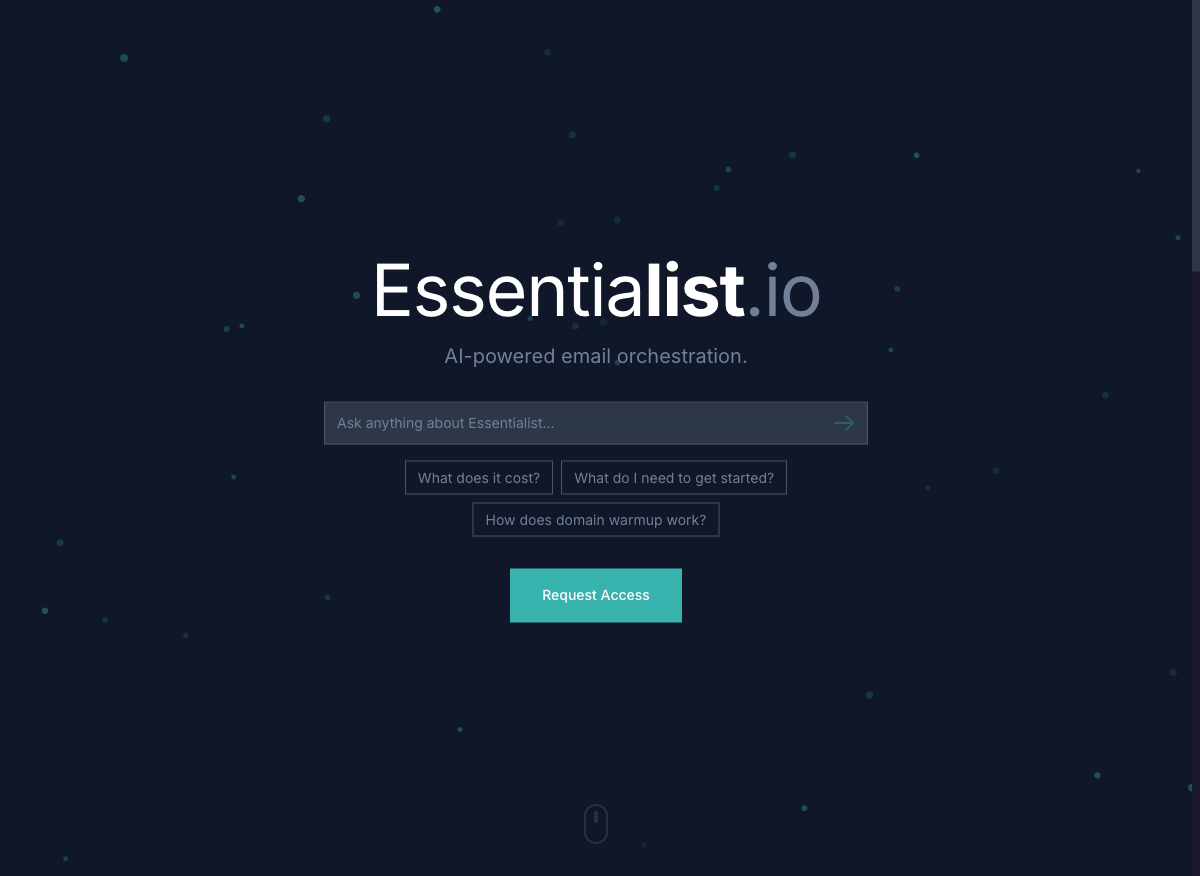
Essentialist.io screenshot

I built Essentialist because I wanted to prove that B2A (Business-to-Agent) is a real category, not a buzzword. The idea is simple: what if a CRM was designed from scratch so that an AI agent — not a human clicking through a dashboard — is the primary user?

The entire platform lives at agents.essentialist.io. There's no dashboard. No login screen. No UI at all. An agent hits the capabilities endpoint, gets back structured JSON describing 22 API endpoints, and can go from zero to operational in two API calls. Register, get an API key, create a campaign, start sending. The platform scrapes your website to learn your brand voice, writes personalized email sequences, sends on a warming-safe schedule, reads and classifies every reply, scores engagement in real-time, enriches companies with firmographic data, and advances contacts through a full lifecycle pipeline — all autonomously.

The architecture decision I'm most proud of: the capabilities endpoint IS the documentation. There's no separate docs site. The product describes itself in machine-readable JSON, so any agent — Claude Code, OpenClaw, whatever — can discover what Essentialist does and start using it without a human reading a single page. I'm using it right now as the email infrastructure for The AI Playbook newsletter. When someone subscribes on theaiplaybook.com, my Claude Code agent calls Essentialist's /api/agent/send endpoint to deliver the welcome email. The agents are talking to each other. That's B2A in practice.

Next.jsSupabaseVercelMailgunHunter.ioUpLeadClaude APIStripeEdge FunctionsPostgres + RLS

Comments

Comments are moderated before appearing.

Your new sales employee lives in your inbox.

Started March 2026
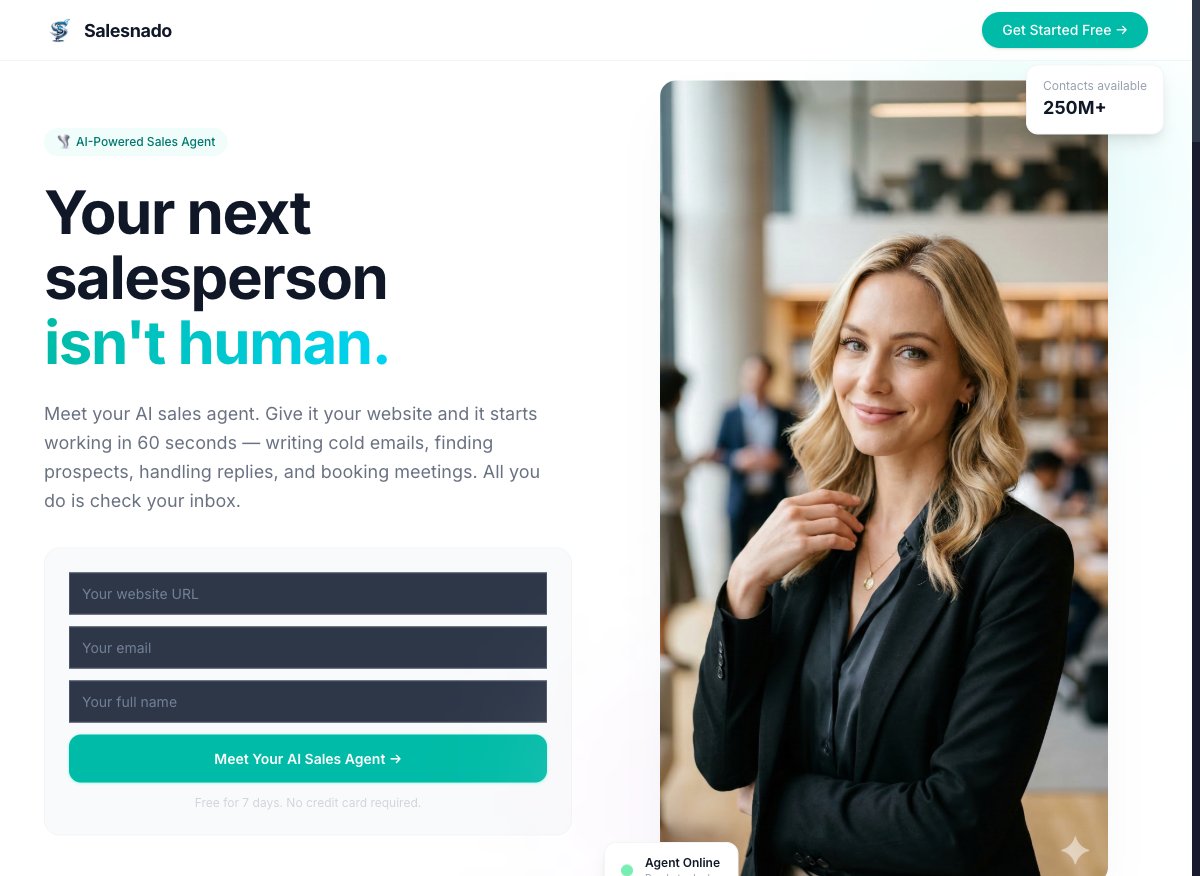
Salesnado screenshot

Salesnado is my attempt at answering a question that's been bugging me: what if hiring a sales rep was as simple as sending an email? No onboarding. No CRM training. No ramp time. You give it your website URL and an email address, and your new AI sales agent starts a conversation with you — asking about your company, your customers, your pitch. It scrapes your site, builds a knowledge base, and starts working.

Once it understands your business, it prospects from a database of 250 million verified contacts, writes personalized 4-part email sequences in your voice, handles every reply autonomously, and when a prospect says yes — it drops a meeting on your calendar with an ICS invite. The entire thing is controlled via email. You text it "status" and it reports back. "Pause" and it stops. No dashboard to learn. No app to download. Just email.

This is a brand new proof of concept — just got it running in March 2026. The thesis is simple: a junior SDR costs $4,000 a month and quits in six months. This costs $149 and never stops. I built it on top of the same Essentialist.io infrastructure, which means it inherits all the warming, verification, and engagement scoring. Early days, but the architecture is proving out.

Next.jsSupabaseVercelMailgunClaude APIHunter.ioUpLeadEssentialist.io

Comments

Keith I’m very interested in a couple of these projects and would like to discuss overlaying some of what you’ve learned on our CRM, Salesforce. In addition I’ve forwarded this to a couple of folks we’re working with to get their thoughts as well. Let me know when you’d have some time to get together. Thanks and we’ll done

Francis Curry · Apr 14, 2026

Comments are moderated before appearing.

A GPS-powered marketplace for fishing spots, built on a lake full of photos.

Started April 2026
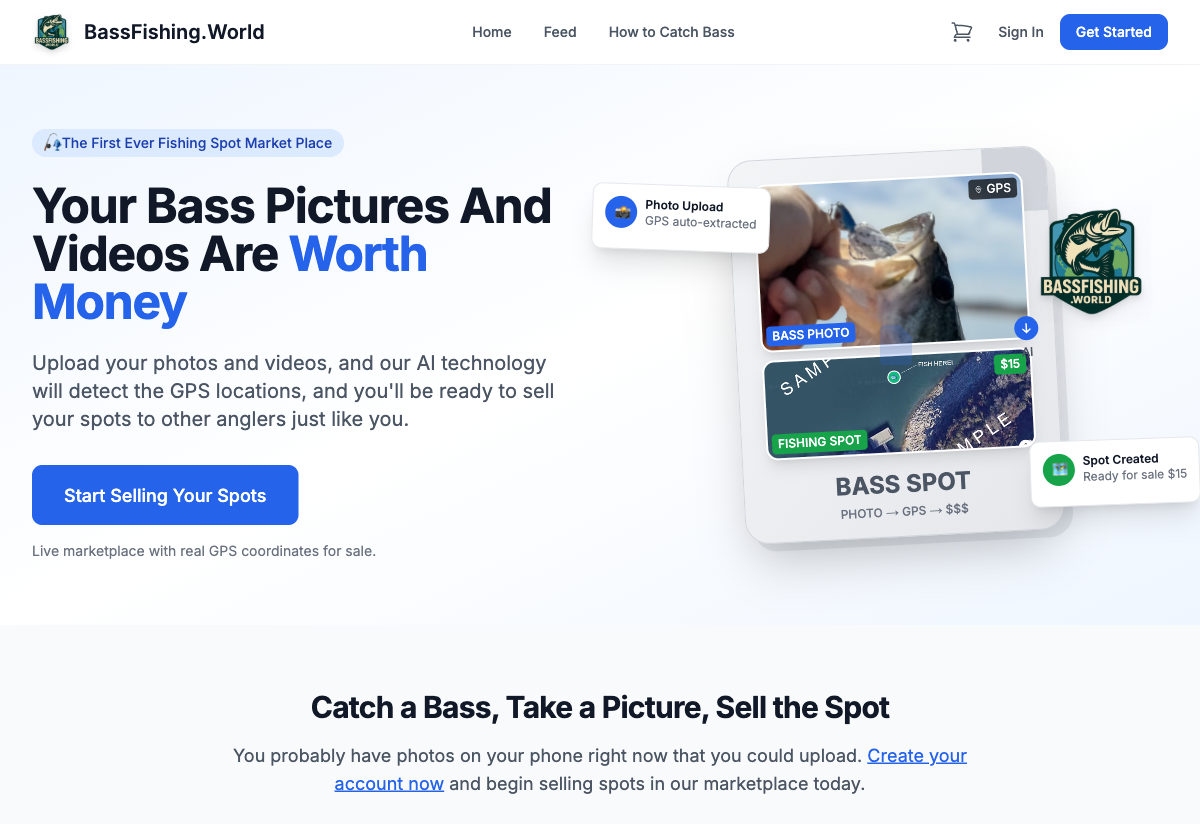
BassFishing.World screenshot

I catch a lot of bass on Lake Travis in Austin, Texas. I also take a lot of photos. One day I realized those photos carry GPS coordinates — exact latitude and longitude of where I was standing when I pulled a 6-pounder out of the water. So I built a marketplace around that idea. Upload a photo, and the app automatically plots the exact spot on Google Maps. Share it, keep it private, or sell it to another angler who wants to fish your honey holes.

It's a progressive web app with an Instagram-like feed on mobile. Anglers can post their catches, comment on each other's photos, and buy or sell fishing spots through a full Stripe marketplace integration. The tech stack is deeper than it looks — Google Maps API for plotting, GPS extraction from EXIF data, Stripe Connect for marketplace payments, Cloudflare for fast and cheap image/video hosting, and an automated blogger that generates images using Gemini. It's fully SEO optimized and already pulling organic traffic from ChatGPT searches.

This one's a labor of love. I haven't sold any spots yet — I'm just trying to get the word out. But the tech is real, the marketplace works, and the concept of monetizing location data from your own photos has legs beyond fishing.

Progressive Web AppGoogle Maps APIStripe ConnectCloudflareGemini APIGPS/EXIF

Comments

Comments are moderated before appearing.

Ideas

Raw thinking. Unfinished. The good kind of half-baked.

Phone It In: a button that calls you and fills out the form

Just came up with this. **Phone It In.** A tiny button at the top of every long web form. You click it, it asks for your mobile, it calls you. The voice agent walks you through every question on the form, you answer out loud, and at the end it says "Thanks — form submitted" and hangs up.

For elderly people. For anyone with bad eyesight. For drivers. For the lazy. For anyone who'd rather talk than type. The form already has the field structure — name, email, address, phone, dropdowns, whatever. The agent just reads the HTML, throws the question set at VAPI, captures the answers in a phone call, formats them, and submits.

Best part: we may not even need the website's permission. Make it a **Chrome extension**. Drops the button in via DOM injection, scrapes the form's field structure, dials VAPI on click. Universal — works on every form on the web that the user can see. The site never knows. The site never has to do anything.

This is a $99/year prosumer extension at minimum. Or B2B sold to insurance/healthcare/financial companies whose customers abandon forms at 60% completion.

Open question: where does it break? Captchas, multi-step flows, dynamic JS forms. But for the long boring static-field forms (DMV, government, insurance enrollment, doctor intake, school registration), this is dead simple.

chrome-extensionvoice-aivapiaccessibilityform-automationprosumer
May 6, 2026

Comments

Comments are moderated before appearing.

CRO Tournament: 32-page landing bracket, winner moves on

What if you didn't A/B test — you March Madness'd it? Spin up 32 versions of a landing page with Claude doing the design variations, then run them bracket-style. Round of 32, Sweet 16, Elite 8, Final Four, championship. Winner moves on, loser dies.

The questions I can't stop chewing on: what confidence percentage do I trust before killing a page? How many impressions per matchup to hit that confidence? A traditional A/B test wants 95% and thousands of conversions per variant — that's brutal for 32 pages. Do I lower the bar for early rounds (80% at 500 visits) and raise it for the finals (95% at 5,000)? Or do I just trust the agent's design intuition plus a lighter statistical gate?

If this works it's not a test — it's an operating system. Every new product launch goes through the tournament. Champion becomes the canonical page. No opinions. No 'I think this headline is better.' Just reps and math. Feels like the same bracket logic I was drawing up for Emailnado's fleet. Maybe that's the pattern — tournaments as the evaluation layer for everything agents generate.

**Update — the bigger play:** we warehouse the winners. Every bracket champion gets stored in a brain of what works. Not just the page — the components. Which headline pattern beat which. Which CTA shape won when the audience was CFOs vs. marketers. Which hero layout converts higher on mobile. Over time the warehouse stops being a graveyard of past experiments and becomes a CRO knowledge base that feeds the next bracket's Round of 32. The agent doesn't start from zero — it starts from 'here are the 32 patterns most likely to win against this audience, go generate variations.'

That's the compound. Every tournament makes the next one smarter. The moat isn't the design — it's the warehouse.

croab-testingagentic-designlanding-pagescompound-learningbrain-of-what-works
Apr 22, 2026

Comments

Comments are moderated before appearing.

The Scientific Method for Marketing: Hypothesis → Test → Outcome → Adjust

What if we built a marketing platform that forces you to think like a scientist? Every campaign starts with a hypothesis — 'I believe [audience] will respond to [message] because [reason].' Then you test it. AI runs the experiment — A/B variants, send patterns, audience segments. You get real outcomes, not vanity metrics. Then the AI helps you adjust the hypothesis and run the next cycle.

This is basically what Emailnado's tournament bracket already does, but the framing changes everything. Most marketers throw spaghetti. Scientists iterate. The flywheel isn't 'send more email' — it's 'get smarter every cycle.' Hypothesis → Test → Outcome → Adjust. Repeat forever. AI doesn't replace the marketer's brain — it accelerates the scientific method so you can run 10 experiments in the time it used to take to run one.

marketingAIscientific-methodemailnado
Apr 16, 2026

Comments

Comments are moderated before appearing.

Fluency — A Daily Personal Development Micro-Course

What if there was a lightweight web app that helped you achieve fluency in personal development the same way immersion teaches language? Every day you get: a snippet to read, a quote or two to memorize, and a small journal prompt. Your responses go straight into your Second Brain. Over time, the neurons rewire. You don't study success — you become fluent in it.

Could be called Fluency, Personal Fluency, or Success Fluency. Draws from the masters: Ziglar, Tracy, Sharma, Robbins, Rohn, Covey, Hill, Clear, McKeown, Collins, Drucker. Not a course you finish — a practice you maintain. Like Duolingo for the language of leadership.

Tech: lightweight Next.js app, Supabase for journal entries, connects to Second Brain vault. Could even be AI-powered — Claude picks the daily content based on what you've been thinking about lately.

personal-developmentfluencyjournalapp-idea
Apr 16, 2026

Comments

Comments are moderated before appearing.

The Scientific Method for Marketing — an AI Flywheel

What if marketing ran like a lab instead of a casino? Every campaign starts with a hypothesis. You test it. You measure the outcome. You adjust. And then you do it again — faster, with AI enhancing every loop.

Hypothesis → Test → Outcome → Adjust → Repeat. That's the scientific method. But nobody in marketing actually runs it that way. They run campaigns, look at a dashboard two weeks later, argue about attribution in a meeting, and then do the same thing next quarter.

What if there was a platform that enforced the loop? AI generates the hypothesis based on your historical data. It designs the test. It measures the outcome in real time. It recommends the adjustment. And the flywheel spins again — each cycle smarter than the last. No more gut-feel marketing. No more "we think this worked." Just: here's what we hypothesized, here's what happened, here's what we're doing next.

marketingai-flywheelscientific-methodplatform
Apr 10, 2026

Comments

Comments are moderated before appearing.

Leadnado: An Agentic Apollo Wrapper That Sells Itself

What if you never had to log into Apollo, ZoomInfo, or any of those confusing CRM enrichment platforms again? Just talk to Leadnado. Tell it who you want to reach and it goes and gets the data for you.

The play is simple: wrap the Apollo API, arbitrage the cost per lead, add a margin, and deliver the results via email. No dashboard. No login. You just say "I need 500 marketing directors in fintech" and Leadnado runs the search, emails you back with a summary, a link to buy the list, and — here's where it gets interesting — a link to have Emailnado or Salesnado sell to them on your behalf.

The tagline: "Stop logging in to confusing CRM enrichment platforms. Just ask Leadnado to go get it for you."

Still working out the economics and how Emailnado fits in. But the idea is a full loop: Leadnado finds them, Emailnado reaches them, Salesnado closes them. All agentic. All via email. No UI anywhere.

leadnadonado-ecosystemb2aapollo
Apr 10, 2026

Comments

Comments are moderated before appearing.

How Many Monitors Does a Vibe Coder Need?

I have 4 monitors on my desk right now. Terminal on one, browser on another, Claude Code on a third, and whatever I'm referencing on the fourth. And honestly? I could probably get away with 2.

But here's the thing — vibe coding isn't about screen real estate. It's about flow state. The monitors aren't for multitasking, they're for not breaking context. Every cmd-tab is a tiny interruption. Every window shuffle is a micro-decision your brain didn't need to make.

Quick LinkedIn hitter: "How many monitors does one need to be a vibe coder? I have 4. How many do you have?" Simple engagement post. Let people argue about it.

linkedinvibe-codingquick-hitterengagement
Mar 27, 2026

Comments

Comments are moderated before appearing.