How is any CTO supposed to make a long-term technology decision right now?
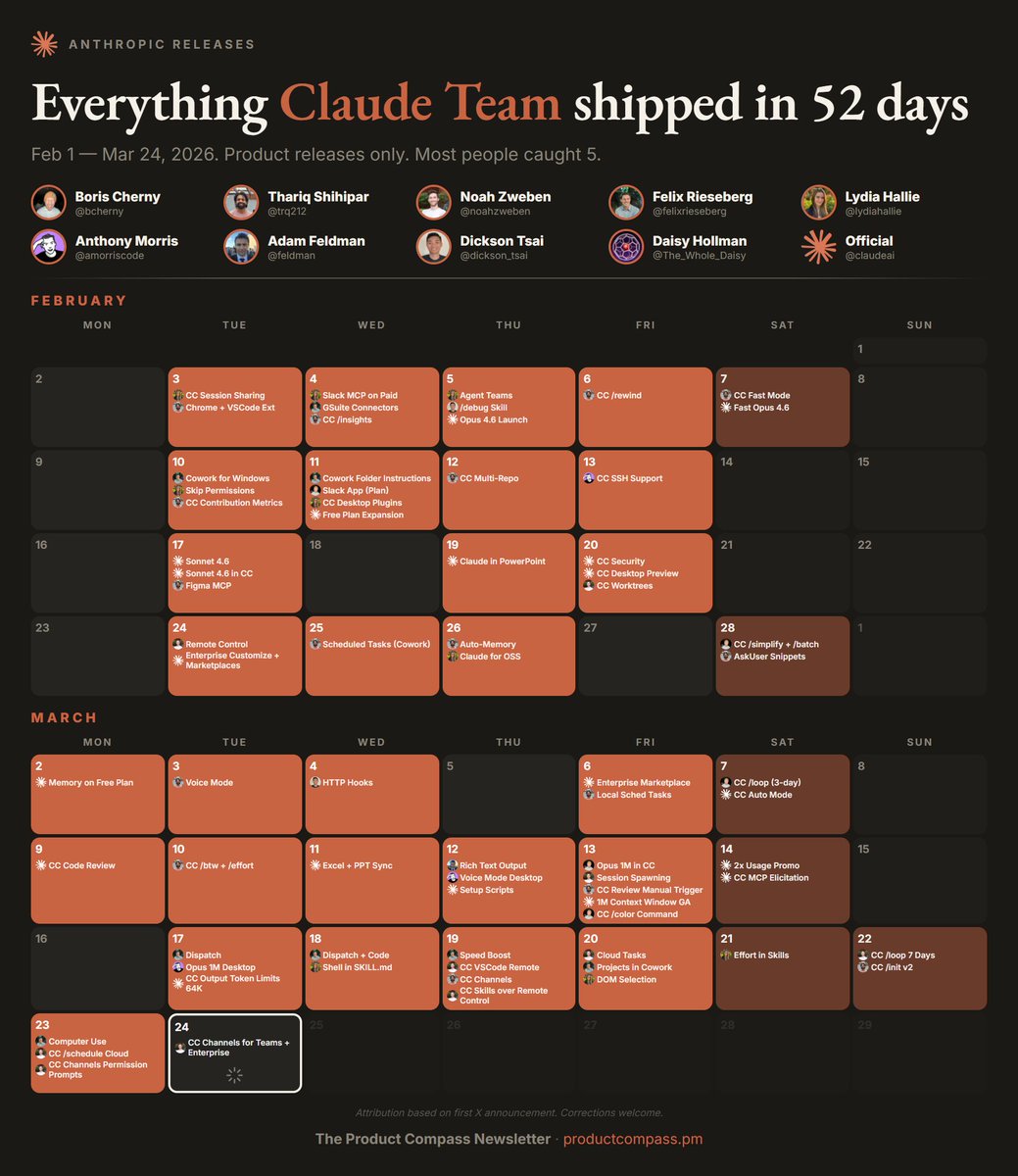
That image is real. Paweł Huryn at Product Compass tracked every Anthropic release from February 1 to March 24. The count: 74 product releases in 52 days. Not blog posts. Not announcements. Shipped product.
Here's what that breaks down to:
- Developer tools (Claude Code) — 28 releases
- Desktop automation (Cowork) — 15 releases
- API and infrastructure — 18 releases
- Models and core platform — 13 releases
And that's just Anthropic. OpenAI launched Frontier in February. Google dropped Gemini 3.1 Flash-Lite. Microsoft built Copilot Cowork — on Anthropic's own technology. Yesterday, Claude launched Computer Use and Dispatch — your AI can now control your mouse, keyboard, and screen.
If you're a CTO at an SMB, you're looking at that calendar and feeling something between excitement and dread.
The Real Problem Isn't the Tools
The tools are amazing. The problem is everything around them:
- Your team evaluated Claude Code two weeks ago — it's already different
- The vendor you picked in January just got leapfrogged
- The integration you built last month needs to be rebuilt for a new API version
- Your board wants an "AI strategy" but the landscape shifts before the deck is done
- Your engineers are excited about 5 different tools and can't agree on one
Sound familiar? You're not alone. 89% of organizations describe their AI approach as "learning as we go." 74% of CIOs regret at least one vendor decision from the last 18 months.
And here's the kicker from Harvard Business Review: AI doesn't reduce work — it intensifies it. They call it "AI brain fry." More tools, more oversight, more decisions, fewer mental resources for the decisions that actually matter.
What the Fast Companies Are Actually Doing
The companies making headlines aren't waiting for the landscape to stabilize. But look closely — the results are mixed:
-
Shopify — Tobi Lütke told every team: prove AI can't do the job before you hire. Hiring freeze overnight.
-
Klarna — went full AI-first. Cut 40% of headcount. AI chatbot replaced 700 jobs. Then reversed course after customer satisfaction tanked.
-
Duolingo — went "AI-first", cut contractors. CEO later clarified they're still hiring at the same speed.
-
Q1Media (my company) — I told all ten of my developers to stop writing code. Not a layoff — a promotion. They're now micro-CTOs and product managers. They define the architecture, review the output, and let AI agents do the typing. Productivity didn't just go up — the nature of the work changed entirely.
The pattern from the big names: bold AI-first announcements → messy reality → course correction. That's not a playbook. That's a warning.
A Framework for CTOs Who Can't Pause
You can't stop the firehose. But you can build a system for handling it:
I. Separate the signal from the noise.
Not every release matters to you. Of Anthropic's 74 releases, maybe 3-5 are relevant to your stack. Track the changelogs, but filter ruthlessly. Ask: "Does this change what we're building or how we're building it?"
II. Make 90-day bets, not 3-year plans.
The Conference Board recommends structured 12-18 month AI roadmaps. I think that's still too long. Make 90-day bets. Ship a proof of concept. Measure. Decide to scale or kill. Repeat.
III. Pick your layer, not your vendor.
Don't bet on Claude vs GPT vs Gemini. Bet on the layer: MCP for tool integration, A2A for agent coordination. The protocols are stabilizing even as the models churn. Build on the standards, swap the models.
IV. Watch the governance gap.
82% of executives feel confident their AI policies are solid. Only 14.4% of AI agents went live with full security approval. That gap is where careers end. Kellogg research shows most SMBs are stuck at Stage 1 of AI adoption. Don't skip to Stage 4 and hope governance catches up.
V. Use fewer tools, not more.
HBR's research found that a small set of AI tools aligned with productivity gains. Adding more tools reduced those gains. More is not better. Pick two or three. Go deep.
What I'm Watching
-
Claude Team is Shipping Like Crazy by Paweł Huryn at Product Compass — The release calendar that inspired this issue. If you want to understand Anthropic's velocity, this is the definitive breakdown.
-
AI Doesn't Reduce Work — It Intensifies It by Harvard Business Review — The most important counternarrative to "AI makes everything easier." Required reading for anyone managing a team through this transition.
-
CIO Playbook 2026 by TechFinitive — What technology leaders actually think about enterprise AI adoption. The 74% regret stat alone is worth the read.
The Bottom Line
74 releases in 52 days. And that's one company.
At that point, you're not choosing between AI tools. You're choosing a strategy for operating in permanent uncertainty. The CTOs who thrive in 2026 won't be the ones who picked the right model — they'll be the ones who built systems that work regardless of which model is on top next Tuesday.